
Think about it. Nobody really wants to spend their day updating CRM records or navigating ERP screens.
Salespeople want to close deals. Finance teams want accurate numbers and invoices processed. Businesses want things to get done.
Yet, for decades, we’ve designed enterprise software around people operating applications.
We log in, navigate screens, update records, trigger workflows and move between systems. And we’ve spent billions making those interactions easier and more efficient.
Now AI is challenging that fundamental assumption.
What if getting work done no longer requires us to interact with software in the traditional way?
We’re already seeing this shift. SaaS vendors are introducing agents into business processes, exposing capabilities through AI platforms and bringing workflows into tools people already use. But I think there’s something bigger happening here than simply adding AI assistants to applications.
We're moving from a world where people operate software to one where software increasingly does the work for them.
From business applications to business intent
Take a typical customer renewal process.
Today, a salesperson might work across CRM, CPQ, contract management and ERP to review customer information, validate pricing, prepare a proposal and coordinate approvals.
Multiple systems, interfaces and handovers.
Now imagine simply asking:
“Review this customer’s renewal, assess commercial risks, prepare a proposal based on our pricing policies and route it for approval.”
An AI agent could gather context, interpret information, coordinate the necessary steps and execute permitted actions across systems.
Of course, the salesperson still brings the human touch to customer relationships and negotiations, makes commercial decisions and validates outcomes where necessary.
And the underlying applications haven’t disappeared either. Their data, business logic and transactional capabilities are still very much needed. What’s changing is how we consume and coordinate those capabilities.
Instead of people navigating multiple applications to complete a process, software can increasingly coordinate the work for them.
And that raises some interesting questions about how we design SaaS products going forward.
The architecture needs to evolve too
This is the part I find particularly interesting.
Having spent years building software and delivering technology transformations, I’ve seen how much effort goes into connecting applications and making business processes work across functions.
We build integrations, APIs, workflow engines, automation and data platforms. Yet so much of the business logic and process execution still sits within individual application boundaries. And after decades of customizations, changes and transformation cycles, that logic can become so fragmented that even understanding where things happen, and why, becomes difficult.
AI agents and multi-agent orchestration are starting to change how we think about this.
I see the architecture evolving around three logical layers:
1. Execution Layer — Deterministic business logic
ERP, CRM, other SaaS platforms and domain services continue to manage transactions, enforce business rules and maintain data integrity.
An agent might recommend a discount, but the pricing service must still validate it against approved commercial rules.
2. Adaptation Layer — Probabilistic reasoning
AI agents interpret intent, understand business context, handle ambiguity, plan tasks and decide how to use available capabilities. This allows us to introduce flexibility into processes that previously needed rigid workflows or manual intervention.
3. Coordination Layer — Orchestration and control
This layer coordinates agents, services and business processes. It manages sequencing, approvals, exceptions and recovery when things don’t go as planned.
Of course, identity, authorization, governance, business context and observability need to work across all these layers.
This doesn't mean building three separate platforms. It's about separating responsibilities while ensuring they work together as one architecture.
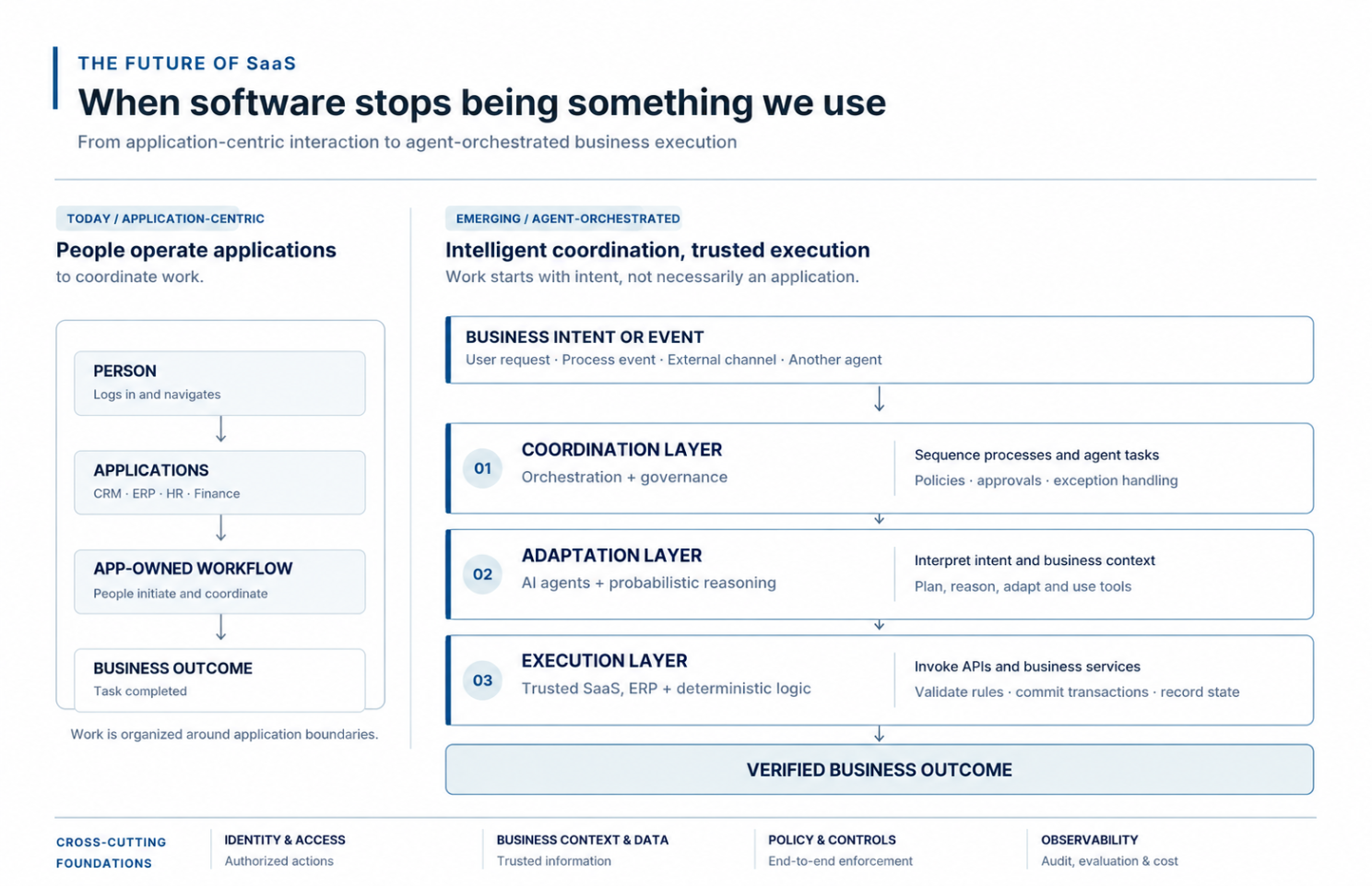
Download article figure (PNG) · Related Architecture Library reference ↗ · Editable draw.io reference
The important distinction for me is:
Probabilistic intelligence to understand and adapt. Deterministic controls to execute reliably.
We shouldn’t expect AI agents to replace the transactional integrity and business rules that enterprise systems have spent decades building.
And simply putting an AI assistant in front of an existing application doesn’t automatically make that application ready for agent-driven execution.
There’s quite a bit of architectural work underneath to make that possible reliably and safely.
What does this mean for SaaS companies?
I don’t think enterprise applications are going away.
An ERP or CRM is much more than its user interface. These systems contain years of accumulated business logic, data, processes, controls and domain knowledge.
In fact, I think some of these platforms could become even more valuable as trusted execution engines.
But their role, and potentially their competitive advantage, is changing. Some applications might become less visible to users while continuing to execute critical business operations behind the scenes.
Others, particularly those differentiated mainly by their interfaces or relatively simple workflows, could face increasing pressure.
And we may see entirely new products emerging that coordinate business processes across multiple SaaS platforms.
Which brings me to a question I’ve been thinking about:
If customers no longer need to open your application to get value from it, what exactly is your competitive advantage?
Is it the interface? The data? The business logic? Or the ability to reliably execute valuable business capabilities?
There’s also the business model question.
When AI agents start doing work previously performed by human users, what happens to traditional seat-based licensing?
The relationship between users, software consumption and business value is already changing. That’s probably a discussion worth having in its own right.
Where I think this is heading
I don’t see a future without enterprise applications.
I see a future where directly interacting with those applications becomes less necessary for getting everyday work done.
Some processes will remain human-driven. Others will be AI-assisted. And more well-defined activities will become autonomous, operating within governed boundaries.
For SaaS providers, I think this goes well beyond adding AI features.
It means reconsidering where business capabilities live, how they’re exposed, how processes are coordinated and where the real value of the product sits.
We’ve spent decades building better software for people to operate.
Perhaps the next chapter of SaaS is about building software that can operate on our behalf.
And that changes much more than the user interface.
Curious how others see this evolving. Will the next generation of SaaS be defined by smarter applications, or by platforms that make the applications themselves increasingly invisible?
Originally published on LinkedIn on October 21, 2026. The author's publication archive is now hosted here as well.